Shadow-Flicker
Shadow flicker describes the stroboscopic effect of sunlight periodically interrupted by turbine blades as they turn. It generally happens in the morning or in the evening when the sun is low in the sky. It is of interest primarily in residential locations. (Moving vehicles may experience a similar effect by driving down a road with telephone poles, so the presence or absence of turbines is immaterial). It is caused when the rotor plane of the turbine is between the observer and the sun.
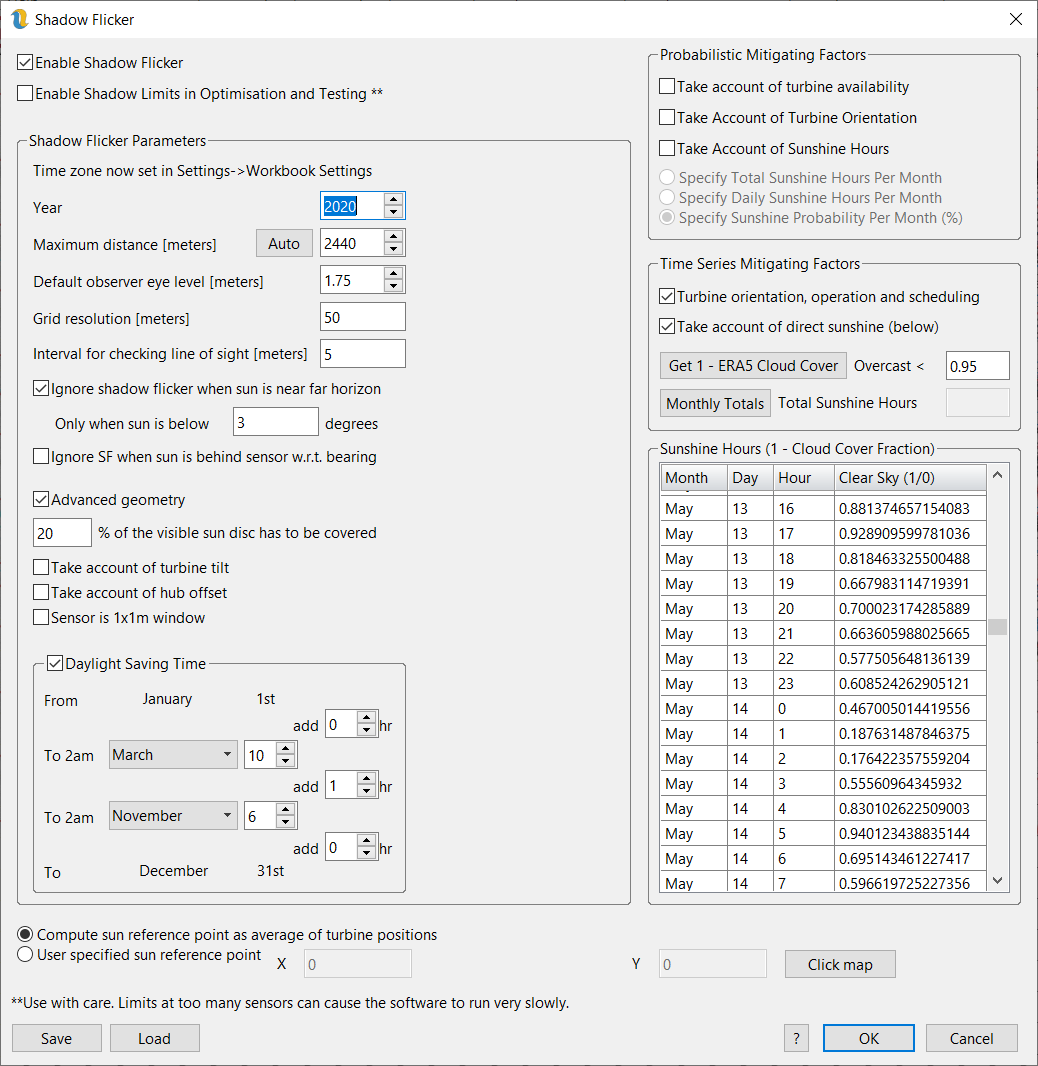
Figure 1: Shadow Flicker Options
Shadow flicker analysis can be run as a grid in a similar manner to the noise and ZVI models. However, even multithreaded on a modern PC, it still takes a considerable amount of time to run. As a result, we recommend that users generally make do with assessing the shadow flicker at individual sensitive locations rather than calculating grids of shadow flicker. Settings are the same for both uses of the shadow flicker module.
The settings are as follows:
Enable Shadow Flicker - This option only affects whether shadow flicker is switched on for calculation in the environmental sensor layers.
Year - This shows the approximate year of commissioning for the wind farm, although the difference in shadow flicker from year to year should be minimal. If you are using time series mitigating factors (see below) then this year should be one for which you have data.
Maximum Distance [meters] - This indicates the maximum distance over which the perceived size of the turbine blade can significantly block the sun (always less than 5km).
- Auto - This uses the current advanced geometry setting for the amount of the sun disk needs to be covered by the blade, in conjunction with the first turbine type on the turbine types list, in order to calculate the maximum distance that a turbine of that type should be capable of causing shadow-flicker. Advanced geometry does not need to be checked for this to work.
Default Observer Eye Level - This would be the default height above ground level at which shadow flicker is evaluated.
Grid Resolution - When a grid is created, this shows the interval in X and Y between consecutive nodes in that grid.
Interval for checking line of sight [meters] – this is the distance interval at which the line between the viewer and the turbine and then the sun (out to max height or the outer limits of the workbook bounding rectangle) is checked for obstructions. Due to recent efficiency improvements, this can be decreased to 1m without a huge impact on the running time.
Ignore shadow flicker when sun is near far horizon - Sunlight is more diffuse when the sun is near the horizon and so less likely to be blocked by a turbine blade. This option is unvalidated but justified by the notion that as the sun approaches the horizon it appears bigger and more diffuse.
Ignore SF when sun is behind sensor w.r.t. bearing -
Advanced geometry - enables the following features:
X % of the visible sun disc has to be covered - this option attempts to take account of the amount of the sun disc which is being obscured by the turbine blade. It uses the blade geometry specified in the turbine type, along with the distance from the viewer, to determine what proportion of the sun’s disc is obscured.
Take account of rotor tilt - treats the rotor disc as tilted by the amount specified in the turbine type. The effect is minor and the increase in computing time can be significant.
Take account of hub offset - the turbine hub is generally not directly above the center of the turbine tower. This option takes account of that although the effect is minor and the increase in computing time can be significant.
Sensor is a 1m x 1m window - this option attempts to copy the approach taken in WindPro. Instead of 1 sun vector in the center, it uses one at each corner of a 1m x 1m window which is centered on the coordinate that would be used without this option enabled. This has a minor effect and can take up to four times as long to calculate.
Daylight savings time - These settings can be used to input the appropriate daylight savings time for the year and locale.
Take account of turbine availability - this multiplies the minutes of shadow flicker by the fraction of time that the turbines are available. It does not affect the shadow flicker calendars.
Take account of turbine orientation* - this uses random numbers to index into the met mast wind distribution to determine the proportion of shadow flicker avoided by the turbine not facing the viewer or not running. It affects the total number of shadow flicker minutes but not the calendars.
Take account of sunshine hours* - this uses random numbers to determine the proportion of shadow flicker avoided by the sun not shining due to cloud cover. It affects the total number of shadow flicker minutes but not the calendars. The number of sunshine hours can be specified as a total per day or per month or as a probability with different values for each month. The reduction in shadow flicker minutes may not exactly match the number input as this functionality uses random numbers to determine whether the sun is shining for each individual minute. The probability of sunshine is understood to be the probability of clear sky and is applied evenly regardless of whether of not the sun is below the horizon.
Specify total sunshine hours per month - this gets converted to a probability of sunshine by dividing by the number of daylight hours in that month.
Specify daily sunshine hours per month - this gets converted to a probability of sunshine by multiplying by the number of days in that month and then dividing by the number of daylight hours in that month.
Specify sunshine probability per month - this is the simplest option to understand and underlies the two options above. If the probability of sunshine in February is 40% then for each minute for which there might be shadow flicker we check if a random number between zero and 1 is below 0.4. If it is not then there is no shadow flicker.
Turbine orientation, operation and scheduling - uses time series data from met mast layers to determine when, for the specified year, the turbine would have been spinning and facing the right way to cause shadow flicker. Affects total shadow flicker minutes as well as calendars.
Take account of direct sunshine - uses hourly sunshine data to mitigate shadow flicker. When Clear sky equals one, the sun is shining and otherwise it is blocked by cloud. This affects both the total number of minutes of shadow flicker as well as the calendars.
- Get 1 - ERA5 Cloud Cover - so long as you have valid credentials for ERA5 single level hourly data on CDS and have them input in Preferences then Openwind can download ERA5 cloud cover for the specified year and subtract it from one to get a clear sky fraction. This is then compared to the threshold for overcast sky. See the section on repairing data in met mast layers for guidance on getting setup with CDS and downloading ERA5 data here
- Overcast < - this is the threshold for overcast sky. It generally needs to be set quite high. Recommended values fall in the range 0.88 to 0.95.
- Monthly Totals - this gives a pop-up summary of the monthly sunshine hours with the current cloud cover data and threshold. Changing the threshold will result in different monthly totals. these can then be compared to other data for source for your site to see which threshold gives the closest match.
There is more about shadow flicker in the section on Environmental Sensor layers including back-calculation of shadow flicker, validity and shutdown loss.
The probabilistic (*) methods above use frequency tables and do not give sensible time series results. The time series methods do give sensible time series results and can be used to take account of turbine scheduling.