Noise-Model
Openwind contains three different noise propagation models to estimate the sound pressure level due to wind turbine noise:
ISO9613-2 – this is the international standard. While it is comparatively simple, this tends to have the advantage that it is fast to compute. It tends to be the dominant model outside of Europe.
Harmonoise – this model is similar to NORD2000. Both model multiple paths from source to receiver.
CNOSSOS-EU (NMBP2008) – this is the official noise model currently being adopted by the European Union. It is based on NMBP2008.
Some elements are common to all three models. For a comprehensive treatment of this subject, it is well worth reading “Wind Farm Noise” (Hansen, Doolan, & Hansen, 2017).
A generic noise propagation model for determining the octave sound pressure level at kth receiver due to the ith turbine is

Where
 is the sound power level at the ith turbine nacelle
 is the directivity index. For a single turbine, the sound power level is assumed to have been measured in the downwind direction and as the model assumes a worst-case scenario of downwind propagation, this can be ignored. However, in cases where a receiver is surrounded by wind turbines, this worst-case scenario is obviously unrealistic and so directivity can be considered to apply a small decrease in the sound pressure level in such cases.
 is the reduction in sound pressure level with distance due to divergence. For point sources, spherical spreading is generally used such that
  and equates to roughly a 6dB decrease in sound pressure level with a doubling of distance. However, in some circumstances or for low frequency sound, 3dB with doubling of distance is used.
 is the atmospheric attenuation which can generally be thought of as sound energy lost to heat. This can vary with temperature, humidity and pressure and the calculation of frequency-based atmospheric attenuation coefficients is common to all the noise models included in Openwind as well as others such as CONCAWE and the Danish low-frequency model.
 refers to ground effects. This includes the effect of sound reflecting off the ground, in the case of water, concrete or other hard surfaces, or being at least partially absorbed, in the case of soft surfaces and dense vegetation. Adiv assumes spherical spreading in all directions and so ground effects are almost always a correction in the other direction (i.e. a negative attenuation) and so add to the overall sound pressure level at the receiver. Ground effects are a major source of differences between noise propagation models and in the more complex models (e.g. NMBP, Harmonoise, NORD2000) are often combined with
  . In the more complex models, the modelling of multiple paths between source and receiver can include some or all of the barrier effects, , as well as meteorological effects,
  .
.- is the attenuation effect of there being no line of sight between source and receiver. In ISO9613-2, this is modelled separately from the ground effect.
- refers to meteorological effects. Generally, the models in Openwind attempt to assume a worst case in terms meteorological effects and so they do not need to be explicitly considered.
 includes any other attenuation effects such as vegetation screening, Af, (an option in ISO9613-2).
The noise produced by different types of turbines is set in the turbine types dialog shown in. At present, it is not possible to input 1/3 octave band sound power levels, but this is slated to be added in a future update. Both Harmonoise and CNOSSOS are valid for octave band as well as 1/3 octave band propagation.
Openwind assumes that reflections from vertical surfaces can be ignored as the wind turbines are aerial sources.
In the descriptions of these noise models, turbines are referred to as “sources” (of noise) and any point at which we calculate the noise level is referred to as a “receiver.” The noise model options dialog is shown in figure 1 below.
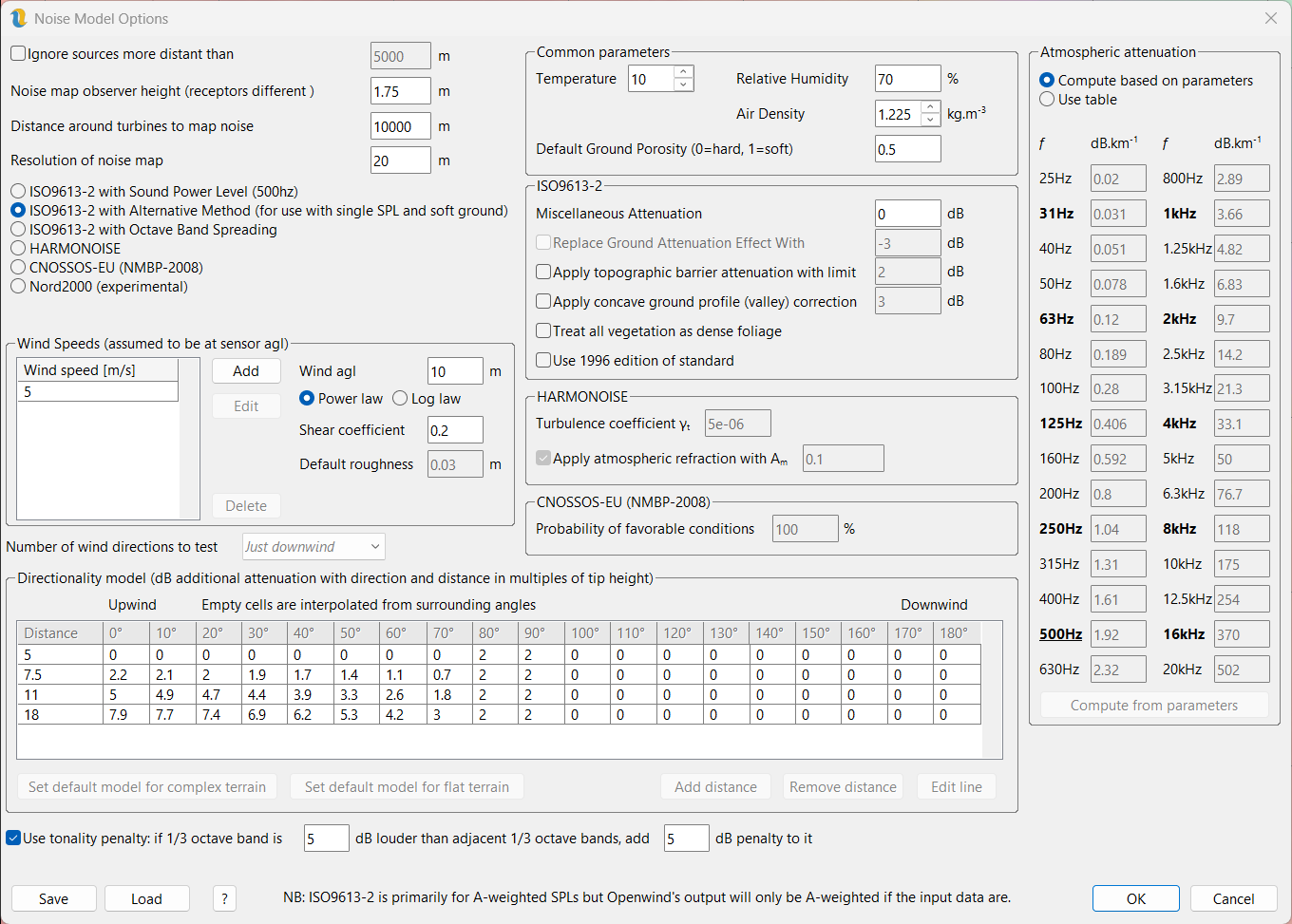
Figure 1: Noise Model Options
Ignore sources more distant than – this option is rarely used but has on occasion been specified as part of a noise regulation and so it is included as an option here.
Noise Map Observer Height - is a factor in calculating the ground effect. By default, it is set at the height for an average to tall person. For environmental sensors, the receptor height is set as a property of each sensor.
Distance around turbines to map noise – used when drawing a noise map.
Resolution of noise map – again only used when drawing a noise map. Be aware that calculation times will increase with the inverse square of the resolution so if resolution is halved, calculation time will quadruple. This should not be an issue on a modern multi-core PC.
Common parameters
Temperature, relative humidity and air density are used to determine the atmospheric attenuation coefficients according to formulae which can be found in ISO9613-1 but tend to be common to all noise models.
Default ground porosity - is also a factor in calculating the ground effect. Soft or porous ground (e.g., soil, vegetation) has a dampening effect as noise energy is absorbed by the surface. On the other hand, hard ground (e.g., concrete, ice, water, tamped earth) tends to reflect the noise energy back upwards towards the listener. Raster layers and polygon vector layers can be interpreted as ground porosity, allowing the user to input detailed information regarding this parameter. For areas that are a mix of hard and porous ground, a value between 0 and 1 can be used to represent the proportion of hard to porous ground. For example, 0.8 would mean 4/5 of the represented area is porous.
ISO9613-2 – these parameters are used exclusively with the ISO9613-2 model. If you are using Harmonoise or CNOSSOS, you may ignore these.
Miscellaneous attenuation - can be positive or negative and effectively allows the user to make an adjustment to the noise levels at all points. A negative value will have the effect of increasing the noise at every point. This may be used, for example, to meet the modelling requirements of a particular municipality.
Apply Topographic Barrier Attenuation with Limit - this option is recommended in ETSU-R-97. It adds an additional attenuation up to the specified limit in situations where there is no direct line of sight between source and receiver.
Apply concave ground profile (valley) correction – again from ETSU-R-97. This option adds 3 dB noise in situations where there is a significant drop in elevation between source and receiver.
Treat all vegetation as foliage - allows the model to take vegetation into account in dampening the noise from the turbines. Any raster or vector layer which the user has specified to be interpreted as “vegetation” can be queried by this method so long that it is appropriately situated within the layer hierarchy.
Use 1996 edition of standard - this is for backwards compatibility only. ISO9613-2024 is very clear that the new version of the standard replaces the old one and is the version that should be used from now on.
Harmonoise – for a description of Harmonoise and its inputs please see (Hansen, Doolan, & Hansen, 2017) or a description of the model here (Salomons, 2011).
Turbulence coefficient

Apply atmospheric refraction with

CNOSSOS – for a description of CNOSSOS and its inputs please see (Hansen, Doolan, & Hansen, 2017) or a description of the model here (Stylianos Kephalopoulos, 2012).
- Probability of favourable conditions with 100% being the worst-case at all times.
Number of wind directions to test – this is another recommendation from ETSU-R-97 (you can find a user guide to implementing this report here ). The assumption of downwind propagation is a useful conservative assumption in general. However, when a dwelling has turbines on opposite sides, this assumption is clearly unrealistic and over-conservative. This method looks at the wind coming from each direction and chooses the single worst case.
Set default model for complex terrain – this fills the directional attenuation coefficients with values appropriate for complex terrain as suggested by ETSU-R-97
Set default model for flat terrain – as above but for flat terrain. It is up to the user to determine whether the terrain is complex or flat.
Add distance – allows distances to be added to the directional attenuation coefficient grid.
Edit Line – allows manual editing of the directional attenuation coefficients. Double clicking in the grid will accomplish the same thing.
When creating a noise map, the model calculates the smallest bounding rectangle for all the turbines in the workbook. The “distance around turbines to map noise” parameter is then used to expand this rectangle. There is no cut-off beyond which the noise from a turbine is ignored.
Resolution of noise map is only used when creating a raster of the noise from the turbines. It represents the distance between the calculation nodes.
ISO 9613-2 is the international standard model for the propagation and attenuation of industrial noise.
Under this standard, all noise sources are treated as point sources; all noise propagation is assumed to be in the same direction as the wind; atmospheric conditions are favourable to noise propagation; and wind speeds that are between 3 and 11 meters above ground level are assumed to be between 1 and 5 m/s.
Three methods are presented in ISO 9613-2 and implemented in Openwind:
Simple A-weighted sound pressure levels (it’s recommended that this method only be used if turbine sound specs by octave band are unavailable)
Alternative method for A-weighted sound pressure levels
Octave band spreading model
The simple model considers the A-weighted sound pressure level from the turbines. When assessing the atmospheric absorption and the ground effect, the terms relating to 500 Hz are assumed to be appropriate.
The alternative method also restricts itself to considering the A-weighted sound together with the atmospheric absorption for 500 Hz. But the ground effect is calculated differently, taking into account the mean height difference between the ground and the line-of-site from source to receiver. This type of effect can best be appreciated when hiking outdoors within earshot of a noise source such as a waterfall. As one walks away from the waterfall, its sound diminishes to a point where it is barely if at all audible. However, scaling an opposite hillside, one can easily find the noise from that waterfall increasing dramatically as the ground drops away. The standard says that this method is only valid for soft ground and so the implementation of this variant does not take account of any ground porosity layers. Alternatively, this effect can be explicitly combined with either of the other two methods by checking the option to apply concave ground profile correction.
The Octave Band Spreading model uses the octave band noise levels defined in the turbine type dialog. It then calculates attenuation separately for each octave band before combining the octave band levels at the receptor.
The following recommendations are taken from (Hansen, Doolan, & Hansen, 2017) and apply when using ISO9613-2:
With exception of propagation over large bodies of water or in urban areas (where G=0), it is recommended to use G=0.5 (where G is ground porosity). G = 1 should not be used.
Uncertainty should be included in turbine sound power levels (+/- 2dB is recommended in the absence of better information)
A receiver height of 4m should be used.
Atmospheric conditions of 10°C and 70% humidity should be used.
Topographic screening effects shouldn’t exceed A_bar_ = 2dB.
Lastly, it is recommended to avoid using the alternative method for A-weighted sound pressure levels entirely (we leave it in for completeness as well as backwards compatibility).
Harmonoise appears to be a refinement of NORD2000 although is not necessarily more accurate. It shares many of the same procedures. Like NORD2000, it considers multiple paths between source and receiver as well as different atmospheric conditions and is the most complex noise propagation model currently implemented in Openwind. Whilst it is primarily intended to use 1/3 octave sound power levels, it is also valid for use with octave sound power levels between 31.5 and 8khz as used in Openwind.
CNOSSOS_EU was originally a French road traffic noise model called NMPB-2008 before being adopted by European Union for the propagation of all industrial noise including from wind turbines. In this model, the attenuation effects of ground, Agr, and barriers, Abar, are combined. This model considers different atmospheric conditions (“unfavourable” neutral conditions leading to lower sound pressure levels and “favourable” downward-refracting conditions leading to higher sound pressure levels) as well as more detailed paths, when compared to the ISO model, between the source and receiver. Similar to the ISO model, this model is valid for octave band spreading from 63hz to 8khz.
In order to calculate sound power levels at multiple wind speeds, use the Add button to add a new wind speed and Del to remove. The wind speeds in the noise settings do not need to match those in the turbine types. The values in the turbine types will be linearly interpolated to wind speed values specified in the noise settings. ISO 9613-2 assumes a 5 m/s wind at 10m above ground level in the direction of the receiver. This means that there is no sensitivity to wind speed within the noise model and so the differences in the results at different wind speeds depends entirely upon the differences in the sound power levels at different wind speeds defined in the turbine types.
When creating noise maps the results will be output for each wind speed and, when octave band spreading is used, for each wind speed and octave.
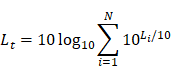
Sound pressure levels are combined for one or more turbines or octave bands, or both, using the following formula: