Effective-Turbulence-Intensity
Effective turbulence intensity (TI) in Openwind is currently an implementation of IEC 61400-1 Edition 3 Amendment 1, Annex D. Effective TI is intended to enable the analysis of fatigue loading due to ambient and wake-induced turbulence.
There are many details of the IEC 61400-1 standard which are left open to interpretation, and in particular, in a random layout (i.e., not gridded layout), whether another turbine is in the same row as the turbine where the effective TI is being calculated, and how to determine how many rows are between the turbine in question and the edge of the array.
The values shown in figure 1 are reasonable defaults apart from the Wohler exponent that should be changed depending on the material comprising the component of interest (e.g. the steel tower would have an exponent of 4 whereas the fibre-glass blades might have an exponent of 10).
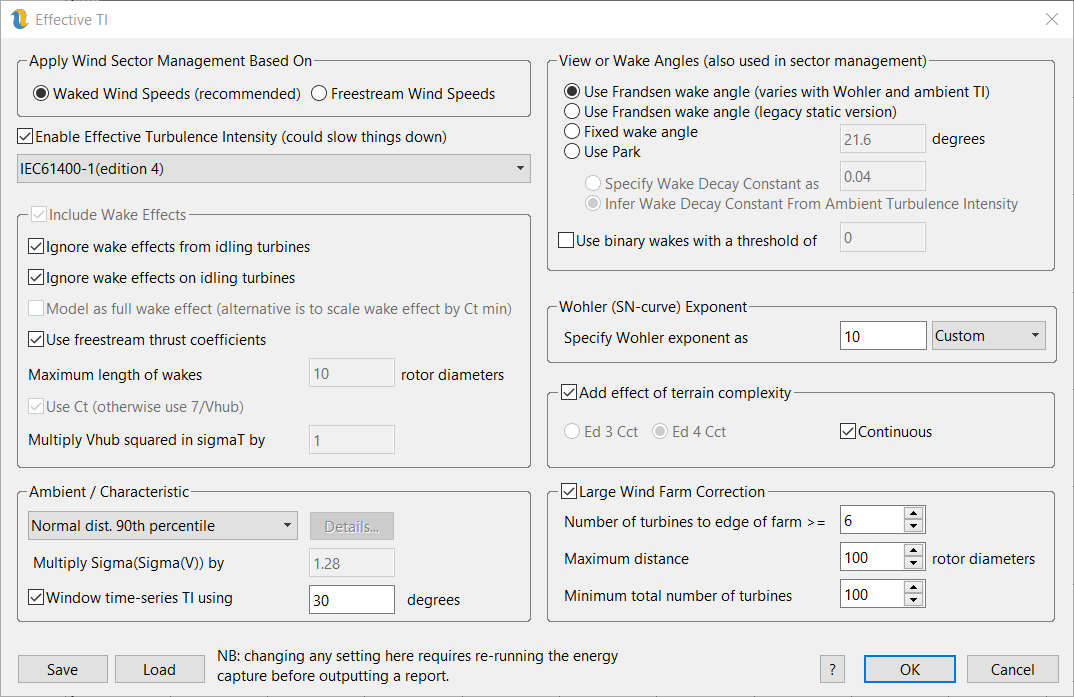
Figure 1: Effective TI Settings
The current implementation of effective TI in Openwind is designed to be fully customisable and the options encompass everything from ambient TI, through characteristic TI, to effective TI in edition 3 and edition 3 amendment 1. Stopped or non-operational turbines are termed “idling” below.
The options and their explanations are as follows:
Enable Effective Turbulence Intensity – this enables the calculation of the turbulence intensity calculation defined below for each wind speed between 1m/s and 30m/s.
Add effect of terrain complexity – applies terrain complexity multipliers (Cct) to the representative TI which forms the unwaked baseline of effective TI. This uses the same terrain complexity calculation as is used in the suitability report for terrain complexity.
Drop list – this has a number of presets, the effects of which are defined in the options below.
Apply Wind Sector Management Based On Waked Wind Speeds / Freestream Wind Speeds – this does not directly affect the calculation defined below but it does in terms of which turbines are spinning for which calculation steps
Include Wake Effects – this means that the wake induced turbulence from upwind turbines is taken account of.
Ignore wake effects from idling turbines - the alternative is that idling turbines generate the wake effect of a turbine with a thrust coefficient of 0.02
Ignore wake effects on idling turbines – the alternative would be to scale the wake induced turbulence by 0.02 over the operating thrust coefficient for that calculation step or
- Model as full wake effect.
Use Freestream thrust coefficients – this ignores the wake effects of upstream turbines on the thrust coefficient of downstream turbines
Maximum length of wakes – wakes are ignored beyond this distance
Use Ct – uses the thrust coefficient from the waking turbine
Multiply Vhub squared in sigmaT – use the “custom” preset to change this value
Use binary wakes with a threshold of – check this option to force the wake multiplier to either 0 (unwaked) or 1 depending on how much of the downwind rotor is covered by the wake of the upwind turbine. A threshold of zero will mean that even the smallest impact of wake is modelled as fully waked.
Normal dist. 90th percentile / Equivalent sigmaC: log-normal / Equivalent sigmaC: Weibull - specify the method used to calculate sigmaC which is the representative ambient turbulence standard deviation described in the explanatory notes for equation E.3 in IEC61400-1 ed4.
- Normal dist. 90th percentile - this is the standard method which calculates sigmaC as the sum of is the estimated ambient turbulence standard deviation plus 1.28 times the estimated standard deviation of the ambient turbulence standard deviation; 1.28 being the number of standard deviations from the mean that is the 90th percentile. The problem with this of course is that standard deviation can never be negative and yet this method assumes a zero mean.
- Equivalent sigmaC: log-normal - for each level, wind speed and direction bin (where values by direction are required), Openwind assembles a sorted list of values of sigma and then fits a cumulative log-normal curve to the upper portion of the cumulative distribution of sigma. It then uses this fitted curve to read off the 90th percentile value.
- Equivalent sigmaC: Weibull - same as above but fitting a Weibull curve instead of a log-normal curve.
Multiply Sigma(Sigma(V)) by – this is the factor by which to multiply the standard deviation of the standard deviation of the wind speed before it is added to the standard deviation of the wind speed to get the ambient or characteristic TI which is the effective TI without wake effects.
View or Wake Angles
Use Frandsen Wake Angle (varies with Wohler and ambient TI) – this is a geometric wake angle given by Frandsen based on a re-reading.
Use Frandsen Wake Angle (legacy version) – this is our old version of the geometric wake angle given by Frandsen
Fixed wake angle – allows the setting of a fixed wake angle
Use Park
Specify Wake Decay Constant as – the Park model tends to have a wake decay constant between 0.04 and 0.075 depending on the background roughness and/or ambient TI
Infer Wake Decay Constant From Ambient Turbulence Intensity – using this option calculates the wake decay constant as equal to the one half of the turbulence intensity so if TI = 10%, k = 0.05.
Specify Wohler exponent as – this is used to distinguish between different component materials. For instance, steel has a Wohler exponent of 4 whereas fibre glass has a Wohler exponent of 10.
Large Wind Farm Correction – though poorly defined in the standard, we have chosen to adopt a suggestion which was not included in the standard but which gives consistent results and is repeatable across a wide range of turbine layouts. See Annex A
Number of turbines to edge of farm – this is one parameter used to determine whether a turbine is effectively within a large wind farm. There need to be this number of turbines between the turbine under consideration and the edge of the farm and they need to be within a given distance
Maximum distance – see above.
Minimum total number of turbines – below this number of turbines there is no large wind farm correction regardless of any other tests.
Inside large wind farms the characteristic turbulence is modified by a function of the average spacing inside the wind farm. This is where there is some ambiguity in the implementation of the IEC standard. Openwind has to handle irregularly spaced layouts as well as gridded layouts and so needs to be able to generalise the rules described in the IEC standard. Openwind considers a turbine to be in the same row as the turbine under consideration if it is within 45 degrees of a line running orthogonal to the current wind direction. Openwind considers a turbine to be upwind or downwind of the turbine in question if it is within 45 degrees to either side of the current wind direction when viewed from the turbine under consideration. Openwind uses the distances to the nearest adjacent, upwind, and downwind turbines to calculate the inter-row and intra-row spacings. When counting how many rows of turbines are between a turbine and the edge of the wind farm, for this direction, Openwind looks upwind and counts how many turbines are within 14 degrees of the current wind direction and at least 2 rotor diameters apart in the upwind direction. When judging whether there are adjacent turbines within 3 rotor diameters of this turbine, Openwind considers all turbines within 45 degrees of a line running orthogonal to the current wind direction. However, the software requires that there be turbines on both sides for the turbine in question to be considered inside a large wind farm, when there are not enough upwind turbines.
When it comes to considering wake-induced turbulence, the wake width at each point downstream from a turbine is an important factor. (Frandsen, 2007) suggests a method for defining the wake width, which is the default wake width used in figure 1 above. For any direction and wind speed, a turbine is considered to be either wholly inside or outside of another turbine’s wake. This makes for a faster calculation, which converges to the same result as a partial-wake method for sufficiently large arrays.
As a more general consideration, all the effective TI calculations use the free-stream rather than wake-affected wind speeds. This is specified in the IEC standard, which says “No reduction in mean wind speed inside the wind farm shall be assumed.”
The ambient, characteristic or effective TI is output for each turbine for each wind speed as part of the standard energy capture report along with the appropriate IEC curves for comparison.