Basic-Wake-Models
The traditional wake models included in Openwind are the original N. O. Jensen () wake model known as Park, the Modified Park wake model (created by Garrad Hassan), and the Eddy Viscosity wake model (Ainslie, 1988). The N. O. Jensen and Modified Park wake models have the similar parameters due to the common origin of the models. In these models the main tunable parameter is the wake decay constant which determines how quickly the wind field behind the turbine recovers to the freestream.
The parameters for each wake model can be accessed individually from the Settings menu.
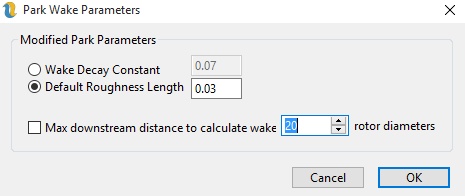
Figure 129: Park Model Parameters
The wake decay constant relates to the default roughness length via the following equation:
Where k is the decay constant, A is a constant equal to 0.5, Z0 is the default roughness length and H is the hub height of the turbine.
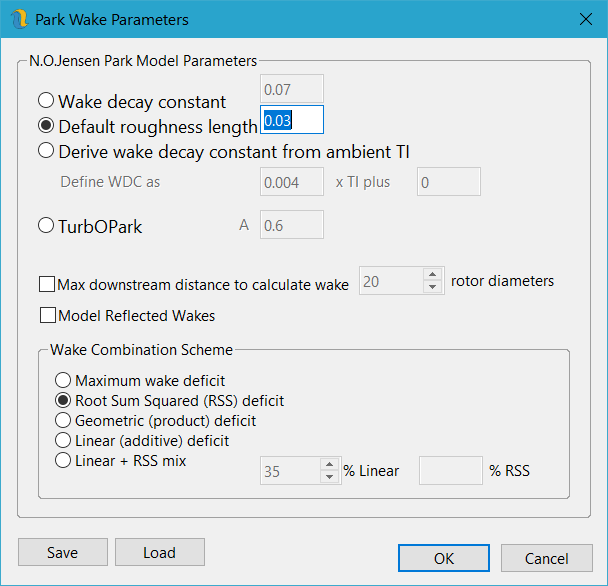
Figure 130: N.O. Jensen Wake Model Parameters
The N. O. Jensen model uses the freestream wind as the incident wind speed at each turbine but combines wakes as the root of the sum of the squares of the deficits. Other wake combination options are available including geometric and linear. In the latest version, the wake decay constant (WDC) can be derived from the ambient TI and wakes can be reflected off the ground in an attempt to make up for the lack of freestream mixing from below. Also we have added our implementation of Nicolai Nygaard’s TurbOPark.
Modified Park also uses the freestream wind speed as the incident wind speed at each turbine but modifies the thrust coefficient according to the incident wind speed. It then simply uses the largest wake deficit for each downstream turbine.
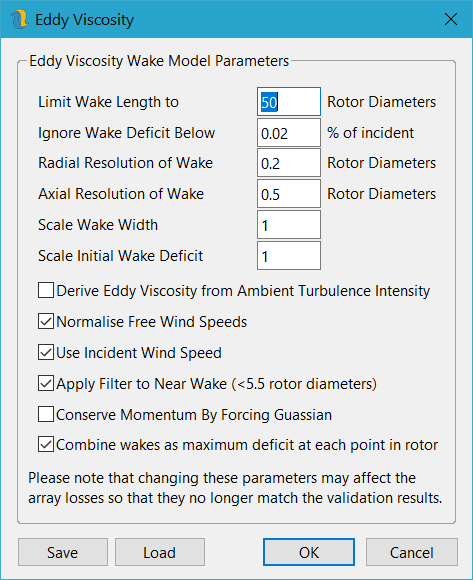
Figure 131: Eddy Viscosity Model Parameters
The Eddy Viscosity wake model is a more complex model based on a solution of the Navier-Stokes equation. The eddy viscosity model has a Gaussian cross-section and the recovery of the wake depends on the turbulence intensity. More turbulence equates to more mixing of the waked wind with the freestream wind around it and so the wake spreads quicker and recovers sooner.
The defaults represent the validated version of this model.
Limit Wake Length to - the maximum length of wake is set to fifty rotor diameters by default but could justifiably be increased to one hundred rotor diameters.
Ignore Wake Deficit Below - this is the minimum wake deficit below which we consider the wake to b fully recovered.
Radial Resolution of Wake - this is a pragmatic choice between increased detail and decreased running time. The default value is a good compromise value. Changing this value will change the evolution of the centreline wake deficit.
Axial Resolution of Wake - this is a pragmatic choice between increased detail and decreased running time. The default value is a good compromise value. Changing this value will change the evolution of the centreline wake deficit.
Scale Wake Width - an optional tuning factor.
Scale Initial Wake Deficit - an optional tuning factor.
Derive Eddy Viscosity from Ambient Turbulence Intensity - if this is not checked, the EV model will use the square root of the sum of the ambient TI squared plus the wake-indued TI squared.
Normalise Free Wind Speeds - sets the value of the free wind speed to 1.0
Use Incident Wind Speeds - calculates the initial wake deficit relative to the incident (waked) wind speed.
Apply Filter to Near Wake (<5.5 rotor diameters) - this is a fix proposed in the original Ainslie paper which has fallen out of favour in recent years. The effect is to slow the wake recovery in the region up to 5.5 rotor diameters behind the rotor. This has the effect of increasing wake losses. We expect to set this check-box to off in an upcoming update.
Conserve Momentum By Forcing Gaussian - this was a fix proposed by Dr Ian Anderson of RES but has not been adopted or tested.
Combine wakes as maximum deficit at each point in rotor - allows multiple wakes from different upwind turbines to be combined across single downwind rotor which is preferable to limiting to the single largest wake impact. However, it does not smooth or redirect between the upwind wakes.
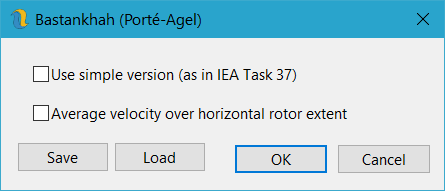
Figure 132: Bastankhah Wake Model Settings
The Bastankhah wake model (also known as the Porté-Agel wake model) is included to allow Openwind to be used in academic exercises which often use this wake model.
Use simple version (as in IEA Task 37) - this is a simplification used in IEA Task 37 on turbine layout optimisation based on the original paper from Bastankhah and Porte-Agel.
Average velocity over horizontal rotor extent - based on equations 4 and 5 from Niayifar & Porte-Agel.